Wednesday, March 2, 2011

Lyme recovery and exercise

I have to be honest.  I've always hated working out, especially at a gym.  I felt clumsy on the treadmill, worried that all eyes were focused on my inability to run at 6.0.  I sometimes had a hard time picking up my feet to merely walk down a sidewalk, and now I was making them do it on a moving object?!  But I sucked up my hatred and went anyway, usually for a few months before I decided I much preferred walking outside... or sitting on my couch. 

Lyme has changed that.  I spent two years on my couch, fatigued.  When I did work out, my muscles and mind gave out, unwilling to power through pain.  My doctor encouraged me to get back to exercise though when he pulled the PICC.  "It strengthens your immune system," he said.  We talked about Dr. B's aerobics recommendation, and I was encouraged to do it anyway, "to tolerance."  Before Lyme, I would have allowed "tolerance" to be a cop-out, giving up on cardio far before I was truly fatigued. 

Not now.  I work out with a trainer to rebuild muscle that was lost over the last two years.  And then I get on the treadmill, set the incline to 2.5, the speed to 3.5, and I power walk, sometimes I even run (though it's far more difficult to read this way).  And I sweat.  I never thought I'd crave exercise, but I do.  I'm thinking of getting a treadmill for my house (the whole toddler mom thing being my major concern) because I need it. 

Before, exercise was a choice.  Then my body gave out, and I couldn't do it anymore.  Through Lyme disease I've recognized how critical it is to keep my body as strong as possible.  I feel guilty eating pizza, not because of the calories, but rather because I know I'm missing out on an opportunity to give my body the nutrients it needs to rebuild (not that I don't indulge every now and then). 

I still may not be able to lose weight because of the metabolic disregulation, but working out isn't for weight management anymore.  It's respect, for my body, for my mind, both of which need the sweat to function at their best.

Wednesday, February 9, 2011

Off antibiotics, now what?

I meant to post a long time ago about being off antibiotics, but then there was Christmas and then all of a sudden it was February, and I still hadn't posted.

I had my PICC line pulled the end of December.  I can't even tell you how good it felt to scratch my poor arm again.  And take a shower without having to worry about water getting underneath bandaging. 

But as good as it was to be off antibiotics, I still had to deal with lingering symptoms.  I think that's why it's taken me so long to post.  Stopping the meds should be a cause for great celebration.  BUT... I am still not better, or at least not better in the way I think I should be.  The fatigue is gone.  The muscle pains are gone.  The migrating joint stiffness is gone.  But I am still dizzy.  I had two weeks in January when I wasn't dizzy, and I thought maybe the Doxy had been causing some of my problem.  But, like always, the dizziness returned.  I also am still having this breathing problem that is either nerve damage or gastrointestinal. 

We ran a heavy metal test, and I just talked to my doctor last week.  My lead and mercury levels are slightly elevated, though my doctor doesn't usually treat in that range.  Given how sensitive I am to everything, though, we decided that heavy metal chelation was at least worth a shot, particularly since I got sick four days after I got a flu shot.  Another thing we discussed was getting another neurologist in the conversation, so I will be headed to Naples, Florida, this Spring to possibly try hyperbaric oxygen therapy. 

My mom has asked how much further I would go in seeking treatment for this dizziness, which is a pretty hard question to answer right now.  I think there are only a couple more routes to pursue before I would have to just accept chronic dizziness.  But for now, there are still options.  So we press on.

Monday, December 13, 2010

I am not a martyr

I read this great post the other day about Media and Resiliency.  Her point was that all you hear in the media is "despite his/her disability, he/she did ___" and that isn't always realistic with chronic illness.  You never hear stories of how much a disability changed a person and how much they CAN'T do.

This morning, I briefly changed my radio station from Christmas music to NPR.  I caught the end of a story of a woman with a heart defect and all the AMAZING things she could do (like go to school).  Don't get me wrong, I think it's great that she's able to overcome her health issues to live a normal life, but I am almost certain that she has bad days, horrible days even that no one wants to talk about. 

Before I got sick I was a teacher.  And before that I worked as a parent advocate and paralegal in a law firm.  I knew disability law and interventions and would happily engage others in a conversation about ADHD and appropriate learning strategies.  Before I got sick, I built a 750 square foot deck with my husband, and we resodded our entire lawn, including laying so much topsoil it took over our driveway.  Before I got sick, I planned.  I had a year-long plan and a five-year plan and could imagine my life into my eighties.  Dan and I could go out to dinner.  I enjoyed a glass of wine with dinner.  I joked.  We played Dance Dance Revolution at night.  We laughed. 

That is not my life anymore.  I can't drink wine.  Going out to dinner is a gamble.  I am bothered by the low-lights, so any nice restaurant is almost immediately rejected.  But I also get dizzy cooking, which is something I also used to love.  There is no way I could build a deck.  And I can barely remember the name of the law I used to spend so much time researching.  I can't work out much.  I'm not sure I can do yoga because of the up and down, movement that causes dizziness.  I can barely play with my son on the floor because of the motion involved and the spinning that results. 

I don't want to be negative, and I'm afraid talking about the things I can't do makes me sound like a whiner.  But really, shouldn't we talk about these things?  Shouldn't we recognize the limits that chronic illness puts on our life?  If the only stories that are ever shared are how we persevere, then no one will ever understand how truly serious this illness, or any chronic illness, can be. 

Sure I want to be seen as strong, but I have just as many low moments where I want to scream and cry and stomp my feet about how unfair this is.  I'm tired of the portrayal of those who live with illness as martyrs.  We aren't.  We're just people, trying to get through the damn day.

Saturday, December 11, 2010

My dizzy theory

In some ways I am thankful for the profound dizziness that has altered my life.  The dizziness is what led me to pursue doctor after doctor for a diagnosis.  It's what led me to Lyme.

But it's also the symptom I can't get rid of. 

I believe I am Lyme free.  Or at least very very close.  I haven't had Lyme symptoms in months.  I had a Bart relapse in September, but we controlled that very quickly.  The only thing left is this damn dizziness (and some breathlessness that started well after treatment). 

A series of unrelated conversations led me to a new theory about the cause of my dizziness.

I have Bell's Palsy.  Bell's Palsy is the paralysis of the seventh cranial nerve, which controls all movement in the face as well as some taste and hearing.  The right side of my face was nearly 100% paralyzed, including my taste buds.  I also had a case of hyperacusis, which basically means that I was unable to regulate the volume of sound.

I have regained much of my facial function back, though it is still very obvious to me that something went terribly wrong.  I hate taking pictures because my right eye is forever slantier than my left.

Sometimes when the nerves regenerate, they screw up.  For example, when I flare my right nostril, it now moves my lower eyelid.  Creepy, I know.  And when I smile, it causes my eye to close slightly.

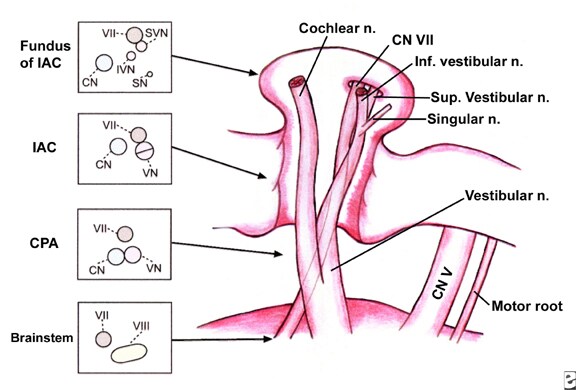
But back to my being dizzy.  I am starting to wonder if the dizziness isn't a result of nerve regeneration gone wrong.  The seventh cranial nerve is very close to the ear as well as very very close to the vestibular system.


Ignore the orange lines.  I posted the image more to demonstrate how close Cranial Nerve VII is to the ear.

The seventh cranial nerve also happens to sit VERY close to the eighth cranial nerve, which is in charge of the vestibular system. 

That picture is maybe hard to understand, but if you look up in the top right, you see CN VII (cranial nerve 7), and right in front of it sits the vestibular nerve.

My theory is that just as my nerve f*ed up by connecting my nose and my eye, it too also may have regenerated incorrectly near my vestibular system, causing chronic dizziness.

I've been thinking about my inner ear's involvement for six weeks or so.  I realized that when I took Xanax for anxiety I also experienced a decrease in dizziness.  I remember an ER doctor telling me that they sometimes used Valium to treat dizziness, so I started researching what it is about that class of drugs that alleviates that symptom.  Apparently, Valium and Xanax are vestibular suppressants that interfere with the nerve endings in the inner ear.

If the Bell's Palsy somehow damaged the vestibular functioning, it would make sense why the only meds I have responded to have been the vestibular suppressants.

The bad news: antibiotics aren't going to fix this.

I have an appointment in person Friday with the Lyme doc, at which point I'm going to show him my theory and see what he thinks.

Thursday, December 9, 2010

My Lyme Disease is not the IDSA Lyme Disease - Brooke

My Lyme disease is not the IDSA Lyme disease.

But it could have been.

On November 6, 2008, I woke up in a foreign place, not knowing that the landscape of my life was about to dramatically change (again).  My house had already burned down while I was eight months pregnant, and my son was six weeks old.  I had just returned to work as a special ed teacher.  I loved my work, and I loved understanding the research behind my teaching.  I was smart, engaged, resilient.

But that morning my orange juice didn't taste right.  I picked up a turkey bacon egg sandwich from Starbucks, too busy to cook breakfast between my newborn, the rebuild, and needing to be at work an hour early to make up for maternity leave.  That didn't taste right either.  By the time my resource students came to me for their writing class I felt like I was talking with braces on even though they had been removed over a decade earlier.  At lunch I went home to nurse my son.  I looked down at his bright blue eyes, and I smiled.  Or rather, I tried to smile.  I jumped out of bed and ran to the mirror to discover that the entire right side of my mouth could not move.  Having always believed if I tried hard enough to do something I could do it, I thought really really hard about smiling and tried to will my muscles to move.  Instead, they sat motionless on my face, the resulting smile a half-moon shaped expression of fear.

I was scared.  I only had another hour left of classes, so I decided to head back to work, not wanting to miss anymore teaching hours.  A half mile down the road, I stopped blinking.  I turned around and we drove to the ER.  The only scenario I could think of was a stroke or cancer.  Why else would someone lose function in the entire right side of their face?  But I was calm.  I had no control in that moment over my paralysis, and the doctors would surely figure out what was happening.

A very kind and confident doctor strolled in a few minutes after we were triaged.

"Bell's Palsy," he said, not even wavering in the diagnosis.  "We see this all the time.  Take some steroids, and you'll regain function in a couple of weeks."

There was nothing benign about my face being paralyzed.  "Are you sure it's nothing else?" I probed, concerned that absolutely no medical tests had been run.  I was told to follow-up with a neurologist.

For the next few weeks, I looked like this:

I know I have posted this picture before, but I feel it is very important to this story to see what the devastation can look like.  I firmly believe that no amount of psychosis could possibly create the paralysis that was so evident to those around me.

I did go to a neurologist.  He said I was fine.

Things got really bad on Thanksgiving.  I couldn't eat.  I was exhausted, and not just new-mom exhausted.  I couldn't move.  Sitting up in my chair seemed laborious.  And I laid down in my dad's guest bedroom and slept while others held my sweet baby boy.  The next day we left for a trip to San Diego.  I needed an escape.  Instead of a relaxing vacation though, we sat in our hotel room, and I slept.  We ordered room service because I was so dizzy, eating out made me nauseated.  I honestly thought I was going to die that week as did my husband who had already considered what he would do if I didn't survive.  I often think back to that trip and wonder if I would have been diagnosed if I had gone to the ER there.

I made myself a promise that if I wasn't better by January I would return to the neurologist.  I wasn't.  He ordered an MRI, and when it came back normal, he told me we would never know the cause of my dizziness.

The next eight months involved eight ER visits for chest pain (inflammation that I didn't learn about until I was diagnosed), routine visits to my GP, including requesting (but never getting) a Lyme test because I had been told by the therapist seeing us for the fire that Bell's Palsy could be Lyme related, and a five month wait to see a much better neurologist.  I also tracked my symptoms and noticed that I got better one week out of every five.

I never went to the internet to self-diagnose.  I trusted my doctors.  Because of my meticulous note taking, my neurologist ordered a lyme panel given the cyclic nature of my symptoms.  I was positive.

But even that wasn't enough to convince the doctors here, and I immediately sought out the opinion of an ILADS-associated doctor who knew far more about Lyme than the doctors in our area who rarely see Lyme.

If the ER doctor had asked about tick exposure in other areas of the country when I presented with Bell's Palsy it is likely I could have saved myself and my insurance thousands of dollars in expensive medical procedures and treatment.  I also would have been given antibiotics instead of steroids, which are known to suppress the immune system.  Because it took a year to even get a Lyme titer run, I have a complicated Lyme case, one that requires a longer course of treatment than the 28 days prescribed by the IDSA.  And my LLMD is very knowledgeable about the other infectious agents, and by treating with a multi-pronged antibiotic regime, we have managed to beat back this disease.

The good news I am better.  My joint pain is gone.  The fatigue that had me bed-bound is now nearly gone.  The neuropathy is gone.  The light sensitivity has abated.

I still have some cognitive deficits.  I used to edit articles and books, and now I struggle with spelling common words.  I also still have unrelenting dizziness that has yet to respond to treatment.  And I have some residuals from the Bell's Palsy. 

Chronic Lyme isn't some concocted diagnosis by patients imagining they are sick.  Nor is it a get-rich-quick scheme manufactured by ILADS.  We are real patients, patients who have suffered the ignorance of not only the medical profession but the community at large.  It takes years to undo the stigma of psychiatric illness, and reducing those who are truly suffering to a bunch of fringe lunatics willing to do anything to cure their psychosomatic problems is not only ignorant, it's morally reprehensible.

I have Lyme Disease.  Only my Lyme Disease is not the IDSA Lyme Disease.

This post is in response to the Tribune article I wrote about here.

MORE STORIES:

Wednesday, December 8, 2010

Dubious medicine a product of dubious journalism

The Chicago Tribune published an article today titled 'Chronic Lyme disease' diagnosis gains traction despite lack of evidence.    In the article, the writers, who can hardly be called journalists, tow the IDSA party line stating that Lyme disease, in its most severe forms, is easily treatable with 10-28 days of antibiotics.  They question the Chronic Lyme diagnosis as essentially a web-phenomenon that is making a handful of Lyme-literate physicians wealthy.

Lyme docs (or LLMDs) often do not take insurance.  They can't.  Their medical licenses have been revoked for prescribing medicine outside the purview of the very narrow antibiotic treatment guidelines.  My doctor, as well as a number of the LLMDs I've encountered in my discerning research, have been touched personally by late stage Lyme.  They aren't doing this to get rich.  They are trying to treat patients who are otherwise cast aside.  If the comments on the Tribune are any indication, there are a number of people who think a trip to the psychiatrist will fix us all right up.  I've also read non-Lyme friendly doctors question how much the placebo effect plays into the recovery of Lyme patients.  Of course, the placebo effect explains why some antibiotics have worked for me and others haven't.  And why the ones I REALLY expected to work, didn't.  And yet because of antibiotics I am, at the least, functionally sick (or chronically well). 

The Tribune then went on to publish another piece in their journal explaining their reasoning behind publishing the original article (I guess they didn't like the Lyme community descending upon them like... ticks).  They reiterate their concern that the overuse of antibiotics by Lyme patients is a public health nightmare and puts everyone at risk.  That argument makes me so livid.  Of course we shouldn't minimize the reality of antibiotic resistance.  But if we can treat zits with long-term antibiotics, I think it's at least worth a shot to try to treat chronic illness the same way.  As LymeMD once said, does it really matter in the end what the offending organism is if the treatment is effective?  And by offending organism, I don't mean a psychosomatic disorder requiring psychiatric help.  There ARE some crazy people who are sick for attention.  But we can't all be crazy. 

Following is my response to the second Tribune article, which I am waiting to be approved:
"Considering your concern for public health and the use of antibiotics, I'm assuming you will be doing a follow up piece on the treatment of acne using long-term antibiotics.  If a possible life-threatening disease is not worth the antibiotic risk, I'm assuming you believe that zits aren't either.
And as numerous commenters pointed out, the use of antibiotics in the meat supply is likely a far greater contributor to antibiotic resistance than use in Late-Stage Lyme patients. 
I think the biggest concern with your article is the obvious oversight in your ability to actually read ANY of the science.  A recent study showed the persistence of Lyme bacteria in "adequately" treated animals.  There are a number of respected scientists examining this issue, and watching any of the recent conferences would, I think, cause you to consider that perhaps this is more than just "modern dubious medicine."
The one thing your article did point out is that as long as it's presumed there is a cure, there is no need for us to continue researching.  Unfortunately, treatment failures do exist, and it is my hope that research will continue so that we can eradicate the multiple chronic infections that have destroyed so many lives."

Let me be very clear: I believe in science.  There are plenty of Lyme conspiracy theories, and I do not believe they help further the sanity of any of those fighting this battle.  I believe in controlled, randomized studies.  I believe in clinical trials (my dad's life was saved by one, even though it did not get FDA approval in the end).  But I also believe that we don't know everything that we need to know, and often clinical judgment is required.  So when I'm looking for a doctor to treat Lyme, a disease that little is known about, you bet your ass I'm going to pay the extra money to go see a doctor who treats Lyme often (as opposed to once in ten years).

I wish that we were ten years down the road in research.  I really do believe there is some incredible research being done at those dubious schools like Columbia!  I thought some great points were raised at the Institute of Medicine's summit on Lyme this year, even if dissenting viewpoints were brought in begrudgingly.

The Tribune did nothing for Lyme patients today.  In fact, they made it more difficult to get recognition by other doctors, doctors I don't go see because of the pervasive attitude like those expressed in today's article.

And the point being made at the end of the article by the patient who was essentially vilified was that maybe if the doctors who turn their head to this epidemic were to fall sick to Chronic Lyme, change, real change, would be made in fighting a disease that so many of us want to just put behind us.

Tuesday, December 7, 2010

Day three off Mepron

So I'm functional. 

But I'm sick. 

The air hunger is decidedly worse.  The dizziness is bad. 

But I'm off the couch, and I can keep down a meal.  How's that for a catch 22?!

I need to restart.  But it's hard knowing it will make me feel worse. 

Have I mentioned how much I hate these cluster of diseases?!

Monday, December 6, 2010

Get sick to get better?

As you might know, Mepron has kicked my ass.  I went from functionally ill to bedridden. 

So I stopped the drug. 

Two days later, and I'm functional again. 

Maybe this is the wrong decision.  I don't know.  Maybe my body will adjust.  Maybe I have to get sick before I get better.  But I'm just not in a place where that's an acceptable response.

There are many in the Lyme community who believe this get sick to get better theory.  They call it a herx, though I've heard people question whether it is the same thing as the initial Herxheimer reaction that occurred with syphilis.  The thing is, though, I've never herxed with any drug.  I've only gotten better.  And then stalled out.

I'm dizzy.  So so dizzy.  And I have to take really deep breaths to feel like I'm getting enough air.  Other than that, I'm better.  I have more energy.  My muscles don't hurt.  My joints don't hurt.  I'm functional, though being dizzy all the time does have some major drawbacks, as I'm sure you can imagine.

The question is do I give up feeling relatively good to go through several weeks of hell to the point that I am literally housebound, in hopes that I feel better in the end?  Are there other alternatives that might not make me as sick?  Is it possible that at this point the meds are causing some of the symptoms? 

I really don't know the answers, but we're going to be bringing this up to the doctor when we go see him next Friday.  For now, I'm resuming my functionally sick life.

Saturday, December 4, 2010

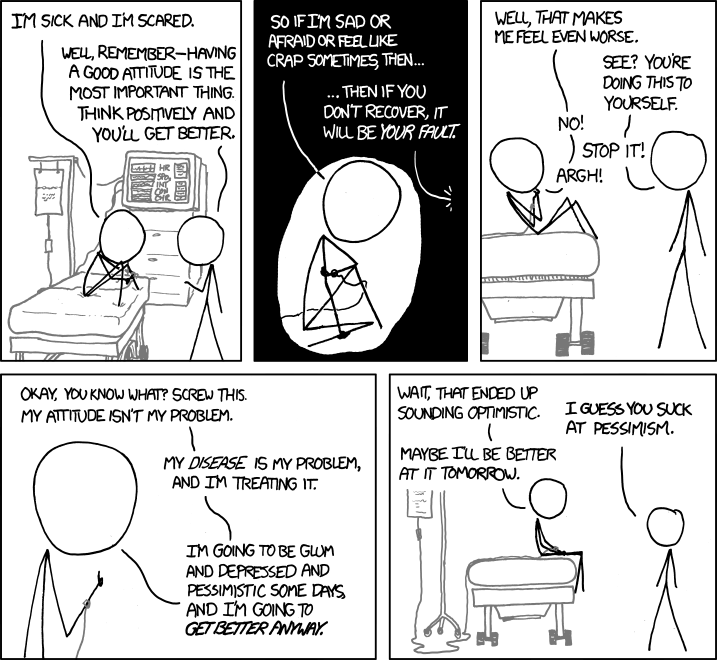
A positive attitude won't cure me


When I was in high school, we attended a Unity Church, which believes very strongly in the power of positive thinking.  One day in my class we talked about being able to use positive thinking to stay well.  I told the teacher it was complete crap!  Bacteria and viruses cause illness, not our thoughts.

A few years ago, the Secret was the big new age thing.  Same principle.  Same objections.  I've always had an issue with the belief that medical problems were simply mind over matter.  An infant is not suffering because of his or her negative thoughts.  I didn't get Lyme because I gossiped.  I got Lyme because a tick bit me.

And I'm not going to get better by willing myself healthy.  I promise you if that were the case, I would be living my life as a very healthy mother.  I feel like sometimes when I complain, others want me to banish the negative, sick thoughts, but really, if they were stuck in bed, barely able to eat, barely able to move really, they might have a few complaints too.

It's not that I don't believe in thinking good thoughts.  I do.  I have been to a hypnotherapist and often listen to my CD before bed to help me sleep better and relax.  But I don't think it's so simple as to think good thoughts.  And it actually rather annoys me to hear such absurdity.

Thursday, December 2, 2010

The Lyme life

It's 7:19.  I just started my IV for the night.  Who'd have ever thought I would become so proficient at doing infusions?!  But they are as much a part of my life now as brushing my teeth. 

The new meds are making me feel pretty badly.  Because of the snow and Kellen's cold (which is now my cold) we haven't left the house much since Thanksgiving.  It's good because I get to rest.  But, I also think the less I do, the more tired I realize I am.  It's easier to think I'm better when I get out of the house, run a few errands, get some fresh air.  Instead, this week I've spent a lot of time watching TV from my couch. 

My appetite is also shot.  I go from being so so hungry that nothing can make me full to a place where absolutely nothing sounds good.  I ordered Chicken Parm from a local restaurant tonight, and it was SO good.  I shouldn't have eaten it all.  I certainly wasn't hungry.  But I ate it.  And it was good to eat a big meal (I ate relatively little at Thanksgiving).  I still have to eat my nightly fat so that I can take Mepron.  I'm hoping egg nog is enough because I don't think I can manage anything else. 

There are so many things on my mind to write, but I'm just so tired.  It's hard for me to believe that this is me, better.  I don't have shooting electric shock pains anymore.  I am not nearly as tired as I was the year I went undiagnosed.  The neuropathy has diminished and is almost nonexistent most weeks.  The joint pain is mostly gone.  These are things to be celebrated.  But now, with this new drug, I am tired again, no energy for celebration.  And I still don't feel like I can get a good breath.  And I'm dizzy.  It's the symptom that won't relent.  I have hope that this combination of meds tips the scales for improvement. 

Tonight I'll listen to my hypnotherapy CD before I go to bed, hopefully giving me another solid ten hours of sleep.

This is the lyme life and certainly not what I imagined my twenties to look like.

Sunday, November 28, 2010

The Mepron Diet

As I said before, I have to take Mepron (the new drug) with fat.  The first night I thought a bowl of ice cream would be sufficient, not realizing it was low-fat.  I learned a hard lesson that they mean business when they tell you to take with fat.

I'm now complying.

I take Mepron twice a day, which means a pretty substantial amount of fat.  I am considering going back to a low-carb, high-fat diet to ensure I don't gain weight while taking this drug, though I am pretty sure my endocrine system as a whole is so screwed up it wouldn't matter what I ate!  And I'm enjoying the egg nog that has become a daily ritual!

Currently my Mepron meal includes:
- three chunks of Tillamook Sharp Cheddar Cheese (Tillamook is the best, in case you were wondering)
- half an avocado
- half glass of egg nog

So far, this seems to be sufficient.  It's a good thing I'm taking this med during the holidays!

Saturday, November 27, 2010

Lyme and pregnancy

Kellen is now two.  I'm starting to feel the baby itch. 

I always wanted several kids.  I'm starting to accept that two might be enough.  But right now we only have one, which is one less than two.  I know that only children grow up just fine.  But I want Kellen to have a sibling.  I want another baby.  I want to have a big enough family that if something happens to me, they have each other.  I know it's a little morbid, but the fire and being sick have made me confront mortality far sooner than I would have preferred.

I always thought four years was a good amount of space between kids.  Of course my mom then tells me that she feels she missed out on a lot of her brother's life because she was in college while he was in high school.  I had my second miscarriage last January, which was probably good in that I needed to be undergoing Lyme treatment.  But I had started to see the benefit of having two kids two years apart.  We're now back to the four year spacing as a likely outcome. 

But, the question really isn't about how far to space our kids anymore.  The real question I face everyday is whether having another baby is really a good idea.  It is well known in the Lyme community that there is something about pregnancy that makes us more susceptible to Lyme.  For some it makes them better, for others, worse.  It also can be passed to the baby.  We know that I've either had Lyme since I was bitten in VA when I was ten OR was bitten in Oregon unknowingly the summer I was pregnant.  So it's possible Kellen has Lyme as well, and he will be tested when we go to Washington in December.  If his test is negative, we will still closely monitor him as congenital cases of Lyme appear to be seronegative (negative blood tests) more frequently.  If I were to get pregnant, I would be on a low dose of antibiotics the whole pregnancy, which reduces the rate of transmission to almost zero.  (I am trying to cite as much of this as I can, but honestly there has been such little research done, I'm having a hard time finding trusted sources.)

My biggest fear isn't about passing Lyme onto a baby.  I know we can control for that.  My biggest fear is for my own health.  I got sick six weeks (SIX WEEKS) postpartum.  Quite frankly, pregnancy scares the shit out of me.  Obviously it wouldn't be a year-long journey to get a diagnosis, but this has been hell.  I haven't been able to enjoy the last two years of my son's life the way I would want to because I have been so sick and so dizzy.  I don't want to spend the first two years of my next child's life sick, fighting this same battle.  My doctor told me this week that it is unlikely I will ever be cured and that a relapse is not only likely, it is almost certain.  If pregnancy makes that more likely, then is that wise?  Or if I'm going to relapse anyway, does it matter?

These are the questions that have been swirling in my head for the last few weeks.  It's one of the reasons I created the new blog.  I wanted a place to be able to talk about how we are looking to complete our family, whether it's through another pregnancy, adoption, or surrogacy. 

Friday, November 26, 2010

Babesia and Mepron

Lyme is so complicated. 

Some symptoms have gotten much much better.  Others have gone away only to return in a frustrating fashion.  The dizziness, though, has not changed at all, except for a couple of weeks (over the course of two years) where it disappeared and gave me a glimmer of a normal, healthy, lyme-free life. 

I also started getting breathless in June.  I had been working out with a trainer, trying to regain two years of inactivity.  But I stopped because I was struggling to breathe.  We've tried everything to figure out the cause of this "air hunger" from reflux meds to asthma treatment.  Nothing has worked.

Air hunger is a known symptom of a lyme co-infection, Babesia.  Even though I had some symptoms of Babesia, we really didn't think that was a problem for me given that I didn't have fevers.  But I don't run fevers.  Ever.  My appendix ruptured in 2002, and I was VERY VERY sick, and yet the highest my temperature got was barely over 100, and by the time we went to the ER, it was 99 degrees. 

During my last phone appointment, my doctor decided to test for Babesia.  My test was barely positive, though I imagine it's a little like being pregnant where you either have it or you don't.  So we're going ahead with treatment.

I picked up my Mepron, also an anti-malarial, the night before Thanksgiving and swallowed the first of many thick, yellow, liquid doses.  There's a segment of moms who refer to their breastmilk as liquid gold (which quite frankly nauseates me).  I've decided that Mepron actually is liquid gold.  I should film a video of how thick this stuff is. 

My mom asked why I took it the night before Thanksgiving.  Well, my COBRA ends early in the year, and this drug is $1100 for three weeks.  I'm on a time crunch, and even Thanksgiving is not so important as to impede medical progress. 

Mepron has made me the absolute sickest of all of the drugs.  Within a few minutes of taking the drug, I feel nauseated.  If you don't take it with 30-40 g of fat, it can cause all kinds of digestion issues, which I learned the hard way Wednesday night.  I get a headache within an hour.  It causes sweats and body pains.  But it's worth it.  There is a theory in Lyme treatment that you have to get worse to get better.  I believe in this drug.  I think it might be the missing piece to reclaiming my health... and my life.  And I'll take the side effects to get there. 

Tuesday, October 5, 2010

Chronic Disease choices

I remember hearing a few years ago someone talk about the reality that when we say "yes" to one thing, we say "no" to another. That isn't any truer than when you are sick.

Some of the choices I have to make each day:

- Whether to go to bed early or read to my son at night. I have a portable IV pump, which was supposed to make this a moot point, but after the night when I had a line full (yes full) of air, I decided the best thing was to stay still during my infusion. We put Kellen to bed, and then I start my meds, which means I finish after 10.

- Coffee or extreme fatigue. Kellen gets up between 6 and 7 every morning. Since I don't finish infusing until after 10, I often am awake until close to 11. I'm lucky if I get eight hours of sleep. Dan goes to school, and then I have Kellen. He's taking swimming lessons, so my only real option if I'm going to survive the morning is some form of caffeine. I have stomach problems so this only complicates those. It also means that I likely won't take an afternoon nap, even though I should.

- Pain or well, pain. Speaking of stomach problems, I get to choose between the types of pain I get to experience each day. I have chest wall inflammation (pleurisy in medical speak). I went to the ER several times for chest pain before I learned what was wrong. Advil pretty much reduces the inflammation so that I'm no longer in pain (at least that way). But if I take Advil, I risk stomach pain and causing further damage to my GI tract.

- Sugar or no. Because of the systemic overload of bacteria, a lot of lyme patients have trouble with things like yeast overgrowth, and as a result are encouraged to eat a low carb diet. The problem for me is that not eating sugar has led to hypoglycemia, which causes dizziness. I'm already dizzy enough, TYVM. I am currently on the "fuck-it-diet."

- Pixar or Bravo. I would just like to thank Pixar for creating such brilliant kids movies. They are actually quite enjoyable for adults. As much as it saddens me that Kellen watches so much TV, some days that's how we survive. We have already decided that Kellen will be getting more DVDs for Christmas because I know nearly every word to Cars. I'd love to find Lion King (though I think it's in the "vault"). We're also looking at Ratatoille and Aristocats. I'd love other suggestions. I used to have a great disney collection, but they are no longer in existence! (The movies we do have are Cars, Up, Nemo, Shrek (all 3), Toy Story, A Bug's Life, Tarzan, Happy Feet.)

--
On another note, several blogging friends have asked what they can do to help. I've been thinking about that, and I think the greatest thing would be cards. There is something about opening the mail to find a personal card that brings a smile to my face. It reminds us we are thought of. I used to have a large collection of cards, which burned up in the fire. I've been trying to decide if I should post my address or get a P.O. Box. Our address has been so publicized that I don't know if publishing it again would matter much. But I'm also a little nervous about doing so. More details this week. Thank you all for caring. The support I've gotten in the last couple of days has been overwhelming. Thank you.

Monday, October 4, 2010

It's not enough to just be alive

I apologize if the title is shocking.

I've been reading this morning more tales of Lyme and re-watched the trailer to Under Our Skin (which used to be available online but apparently isn't anymore).

Someone said it isn't enough to be alive. Oh how that resonated with me this week. There was a time where simply being alive was enough. I could appreciate the pleasantness of life just simply by being.

That's not enough.

Just being is too painful. My body hurts, my head spins, I feel exhausted both physically and mentally. Living for the sake of living is not enough for me. I have to find other reasons to live.

I was talking recently to another Lyme survivor on Twitter about good and bad days. She said something about counting the moments not the days or the weeks. That phrase has changed my life. I certainly am not yet able to count good months. I am barely able to count good weeks. I can sometimes count good days. But I can always count good moments. I am so used to quantifying my life more globally, so each day was good or bad. And when I strung bad days together one after the next, my life seemed pretty gloomy. Let's be real, it is pretty sad.

But no matter how bad my day is there is ALWAYS a good moment that interrupts the bad.

It might be Kellen giggling with me when we are singing on the couch. Or lying in bed with him asking to read the "Be Butt" book (belly button). There is joy in picking the ripened tomatoes off the vine or walking out to the mailbox to find an unexpected card.

This illness has made me painfully aware of how those moments can save us from our pain, our suffering. It's no longer enough for me to just be alive. I have to live in those moments, stringing one second of joy to another in hopes that I will create a necklace of days that turn into weeks and eventually into months.

Sunday, October 3, 2010

Letter to Family and Friends

Has it really been over two weeks since my last post? Time just seems to melt, one day into the next into the next. Several of my symptoms have returned, and it was all I could do to hold it together for Kellen's birthday party. I'm now recovering from that day even though it's over a week later.

Last night I came across a post from Infectiously Optimistic with a letter to friends and family explaining her Lyme disease and the struggle she endures day after day (please read this if anyone you know suffers with chronic illness. It's really beneficial). I have been struggling lately with how to ask for help from those closest to me. As someone who finds care giving natural, I have a hard time with needing to directly ask for the support I need. I feel like I shouldn't have to explain how to care. But I'm learning that those expectations only breed resentment if I'm not clearer about my needs.

I'm borrowing some of the language from that post in crafting my own letter:

Dear Family and Friends:
I have late stage Lyme Disease.

"Late Stage Lyme Disease is a neurological disease, much like Multiple Sclerosis, Parkinsons, and ALS are. When a person is initially infected with the bacteria, the disease is not neurological in nature and is easily treated with a course of antibiotics, but if the infection goes unnoticed and is left untreated, the bacteria continues to replicate and spread throughout the body. The systemic bacteria is able to morph itself into a resistant form that can hide itself in places in the body that the immune system cannot easily penetrate, like the joints, eyes, and the brain. The patient then becomes a Late Stage Lyme Disease patient.

"I know that this information is controversial, and if you do a google search on it, you are likely to come up with conflicting information. The disease itself devastates a Lyme patient's life, but the controversy surrounding the disease makes it that much harder. Understandably, it breeds doubt amongst other doctors, friends, and family members of a patient. I like to explain it this way though:

"The way Lyme Disease is currently being handled is much like the way AIDS was handled when the AIDS epidemic first arose. Patients who were infected with HIV were doubted, because the infection was so rare, understudied, and controversial. The patients were denied treatment and made to feel as though they were crazy, and that it was all in their head, despite their obvious illness and failing bodies. One of the leading Lyme doctors on the East Coast was actually initially an HIV doctor, and diagnosed one of the first cases of AIDS in North Carolina. He stuck loyal to his HIV patients despite the controversy surrounding the disease. He now primarily treats Late Stage Lyme Patients. It is reported that unfortunately, Lyme Disease is shaping up to look like an even greater epidemic than AIDS. This doctor asserts though, that compared to the research that was being done on HIV in the beginning of the AIDS epidemic, Lyme Disease research right now is alarmingly elementary and rather non-existent.

"I'm sure that controversy exists in the early stages of any new disease or epidemic, because typically the initial reaction to something that we don't understand is to either fear it and avoid it, or ridicule it. Unfortunately though, as this happens, lives are coming to a screeching halt, much like mine has.

"When Lyme Disease moves from it's early stages to its late stages, the symptom list grows exponentially. Initially, a patient may have 2, 3, maybe 4 symptoms that are easily ignored. By the late stage of the disease, the official symptom list expands to over 57 symptoms. This may seem nearly impossible and like an exaggeration, but think of it this way: the brain is the control center for the entire body. If there's an issue in the brain, then virtually anything in the body can go wrong, because the brain is the commander of every organ, cell and function in the body.
"

I do not know when I was bitten by a tick, whether it was the bite in Virginia when I was ten or whether it was a bite when I was pregnant. I've struggled with bizarre medical issues since I was young and have had bouts of extreme fatigue that were inexplicable. But those episodes seemed to be controllable.

After having Kellen, my face went paralyzed, Bell's Palsy, seemingly benign. If I had known then that I had Lyme disease, I could have been treated with antibiotics and hopefully gotten better quickly. Instead, I was prescribed steroids, which is actually devastating to a Lyme patient as it provides an environment ripe for bacteria replication. Because of the fire, my diagnosis was even further delayed because it was easy to assume my symptoms were a stress response or related to my PTSD. Each day from November 2008-September 2009 I continued to get sicker and sicker as the bacteria ravaged my body, most notably my nervous system with profound dizziness, light sensitivity, peripheral neuropathy, shooting electric shock pains down my arms, migrating joint pain, muscle pain, and fatigue merely from waking up. In that time, I probably had thirty healthy days.

Lyme patients are often written off as head cases, merely imagining their symptoms. Why anyone would imagine this hell is beyond my scope of comprehension, and if you knew how badly I felt on a day to day basis, you would never accuse me of hypochondriasis or pretending to be sick for attention. By questioning my diagnosis, you create even further isolation when chronic illness is isolating enough.

Despite the pain in my body, I have continued to try to live something resembling a life. I know to some of you it seems that I am wallowing in self-pity, eager to share my pains with anyone who will listen. You don't see the strength it takes for me to get out of bed and take care of my son. There are days where my only goal is to be able to cook dinner. I endure great pain to live half the life that I imagined I would live at 28. When Kellen goes to the Little Gym, I experience increased dizziness because I'm so sensitive to light and noise. But it's important to me that he not sacrifice because of my illness. We have people over for football games because we enjoy it, and yet the energy I expend cleaning my house and cooking takes me several days to recover from, nevermind the dizziness that comes along with the noise. I can no longer do so many of the things I love (like reading and scrapbooking), so any activity feels like I've crossed the finish line of a marathon.

I know there are many of you who feel that we are neglecting you. My entire day is focused on surviving to the next day, and I'm sorry if I have hurt you or otherwise not been engaged in your life. It is not because I do not care (and I need to remember that just because I haven't from you that it is not because you do not care). As the other blogger noted: "A lot of the time though, when you're chronically sick, you're "out of sight, out of mind" because the nature of normal everyday life tends to swallow up those around you." And because of my illness, I am no longer engaged in normal everyday life with you.

There are also family members who don't understand why we don't make the effort to come over (more). They don't realize that there are days where simply getting out of bed requires incredible effort. I have to give myself an IV infusion everyday for two hours. I have to take my medicine out of the fridge one to two hours before my meds start. While you might not mind my infusing at your house, it feels like a hassle to bring my supplies with me, not to mention the inevitable reality that I will need to drive home connected to my IV. Additionally, if we are at your house, I have to spend more time corralling my son and making sure he doesn't break something or hurt himself. Ultimately it's just so much additional effort for me to go anywhere that we just stay home. On my good days (and hopefully weeks), I'm trying to make up for two years worth of projects. The reality is that I still have yet to fully move in to our house because I've been sick for so long. As I've said many times, we are more than happy to have you over as long as you don't mind the clutter that seems to overtake my house.

The doctor of that blogger said that this disease takes a village to overcome, both in terms of medical professionals and support. She says, "I also believe that at the end of the day, if the patient doesn't have their own village of supportive, accepting, educated family and friends to come home to, the puzzle is incomplete. You just can't do this alone." I know that I cannot beat this alone, both mentally and physically. I know that learning to ask for help is only one small part of my long journey in this life, and I am continually reminded that I need to seek out the support I need. I need you as a part of my village if I am going to come out of this on the other side.

Things you can do to support me:

- Educate yourself about Lyme disease. This is a very controversial disease, but I trust my doctor. No one would question me if the doctor said I had cancer. Please don't question this either. The doctors and patients are, in a way, unlucky to be at the forefront of this disease (possibly a major epidemic) because there is just so much that is unknown and treatment often feels like an arrow flying through the air in a dark room just hoping to land on the target... and if you're especially lucky the bullseye. The documentary Under Our Skin is a great start as is the book Cure Unknown.

- Don't assume that because I've had good weeks that this week is a good one. The worst weeks I've had have followed some of the best weeks because it's so mentally draining to have a bad day after so many good ones.

- Reach out. Chronic illness is, as I said, very isolating. The loneliness only enhances the depression that comes along with this disease. While I may not have the energy to go out to lunch or even get coffee, I need friends, whether you call or come over and hang out for a bit.

- Leave out the puppies and rainbows stuff. Positive thinking is great, but my sharing with you how badly I feel isn't negative thinking. It's just my sharing my struggle with you because I am trying so hard to get you to understand the pain I'm living with so that you don't think my laying on the couch is laziness or made up. I don't need you to tell me to think happy thoughts. If you do, I promise to annoy the heck out of you one day with the same rainbow up the ass crap, and I don't think you'll like it!

- Dinners. Evenings are especially hard for me, so having some frozen meals would be helpful.

- Other household help. Simply doing laundry takes an enormous amount of energy, much less weeding as my meds cause sun sensitivity. Any help is always appreciated.

- Patience. I do believe that I will get through this and get to experience health again. In the meantime, please be patient. If I'm short with you, I don't mean to be. I just don't feel well. If I cancel plans, please know it's not personal. If I don't call for months, I promise I still care.

This journey is hard. But I know I can't do it alone. I need you.

Be well.
Brooke

Sunday, August 22, 2010

Lyme update

As you know, Dan and I flew up to my doctor in Seattle a month ago and had the PICC line placed so that I could start receiving IV antibiotics.

I've been on some version of antibiotics since late last fall, first killing Bartonella and then working with a combo of drugs to attack the Lyme bacteria.

A year ago, I had no idea why I was sick. Each month brought with it an unknown set of new symptoms. I would cycle through the month with a flare up every 35-ish days. I often predicted when I would get sick again because the cycles were so regular. No one wants a diagnosis like this, but at that point, I just wanted to know what the hell was wrong with me!

I have had several people question whether I was legitimately sick and then a few more question the Lyme diagnosis since it is far from fool-proof. But a year later, I have to say, I feel SO much better and am so thankful for the doctors who risk their licenses to treat this disease. I may not be 100%, and I certainly still have some neurologic deficits, but compared to a year ago, I am so much healthier.

The shooting electric shock pain is gone.

Where I used to be tired from doing nothing, I now am only tired from doing. I may still get more easily fatigued than I used to, but at least I can be somewhat productive. (And this week has been a record for energy I think since before I got pregnant TWO AND A HALF YEARS AGO!)

My joints feel much better and are only stiff momentarily in the morning.

The all-over body pain is gone.

I still get dizzy, but it's becoming more and more related to over-stimulation and florescent lights, as opposed to just being dizzy because I'm awake.

I still forget how to spell words sometimes and can find myself lost in a conversation. My eyes still get tired. And the Bell's Palsy isn't fully resolved.

But I am better, and that's a reason to be optimistic that I will make a full recovery!

Wednesday, July 28, 2010

Seattle and Venus

I can't believe it's been 10 days since I last posted.

Dan is finishing up his math class, and should be getting an A (or a high B). It's really an achievement, and his schoolwork is finally starting to recover from the downslide after the fire.

We spent the weekend away in Seattle, our first real weekend away from Kellen. Although we missed him, it didn't hurt to have a weekend away from the constant demanding needs of another human. The first night we were out to a nice dinner on the water, and another family came in with a whiny toddler, and I wanted to tell them that I had a No-toddler-within-50-feet-of-earshot rule while on vacation, but that didn't seem fair! We have certainly caused our share of raucous at restaurants.

Our trip was mostly for my check-up with the Lyme doctor, and we decided to add on a couple days away. This was the view from our hotel room:


We watched cruise ships load and unload passengers as though it were a 24 hour cattle call. We made a mental note that if we ever went on a cruise, we'd arrive late and make sure we could afford to be a VIP.

On Friday, I had a PICC line put in. It's a more permanent IV line that allows me to give myself daily meds that will hopefully penetrate the blood-brain barrier and kick these spirochetes to the ground. After I had it put in, I told Dan we needed to name it. When Dad was sick with cancer and we were being given a five year life expectancy (it's been nine years thanks to a great clinical trial), we named his IV stand Freddie. Whenever it was time to walk around 4-south, one hand on the pole, the other closing his hospital gown, it gave us a momentary laugh to call for Freddie, the IV stand. I guess it personalizes medicine a little and makes it less scary or... medical. Dan decided that we should name it Venus, the intravenous PICC line.

Monday, June 28, 2010

Reflections on Lyme

Lyme has done some awful things to me. I think the worst are the feelings of despair, anxiety, loneliness. The physical symptoms are not permanent. And although it is sometimes hard to believe, the emotional and psychiatric symptoms are not going to linger forever either. No one can understand how disabling this can be if they haven't walked this path. If I said I had cancer or MS, I think people would relate ("oh, so and so has that"). We've made those illnesses a part of our vernacular. Chemotherapy is almost universally understood. As a society, we know what to expect when someone gets those diagnoses. We are compassionate, sympathetic. I know when my dad was diagnosed with cancer, people came out of nowhere with cards, meals, time. Lyme is not yet seen the same.

Late-stage Lyme is debilitating. But it is invisible. There is a great website called "But you don't look sick" that has some great stories about perseverance through invisible illness. I've been called a hypochondriac by people who claim to love me. That's heart-breaking. I sometimes don't have enough energy to get out of bed to make dinner. I certainly don't have the energy to convince someone that my whole body hurts and that I have fatigue that can only be temporarily overcome by several large cups of coffee. I've realized that putting on that front though only makes it less obvious that something is wrong.

I don't want to be a burden to those I care about, so I try to minimize my complaints. But truly, I feel very alone. When my dad was sick, I felt there was no other choice but to move in with him, make sure he was cared for, that healthy food was on the table, that he didn't have to worry about driving home from chemo. Where is my caregiver? I don't mean for that to sound desperate or clingy. I guess I just don't understand. I would do anything for friends and family. Quite frankly, I have, sometimes to a fault to where I haven't left anything for myself and my family.

I am ready to be healthy again. I want to have non-caffeinated energy. I want to be able to work out without feeling crushingly fatigued from lifting ten pounds. And I want a social life back. I know it takes time to maintain friendships, and I feel like I have lost my ability to do that. Mostly I'm just tired of being alone. And being sick is just one more reason for me to feel distant from others.

Wednesday, May 12, 2010

No One Wants Me

I saw my neurologist today. She told me "no one wants Lyme disease." She was referring to doctors, though it is an appropriate statement on many levels. I've been trying to get in to see the infectious disease doctor here (I know that many in the Lyme community think that is a mistake, but it's mine to make, and I can decide how to proceed after meeting with him). The infectious disease society is the overriding medical body who makes Lyme recommendations for diagnosis and treatment.

When I call the receptionist at the ID doc's office (his name is Sky Blue, he he), however, she makes even getting into see him a nightmare. I have been trying to make an appointment for two months. *They* aren't sure he treats Lyme (uh, he should). *They* told me to get a referral. I did. *They* still weren't sure the doc could see me. *They* told me someone would call me after talking to him. *They* didn't. My neurologist said no doctor wants Lyme. I can understand.

Lyme disease is so full of controversy. On one side is the IDSA (infectious disease society of America- though don't let the "America" fool you; many other countries follow their guidelines). They posit that Lyme is an easily diagnosed and treated disease. They believe that even if you have late stage Lyme (which causes neurological problems and arthritis-like symptoms), it is treatable with four weeks of antibiotics.

On the other side is ILADS (international lyme and associated diseases society). They believe that Lyme is much more complex and is very difficult to diagnose and treat. They argue that many people with late stage lyme are "seronegative" (meaning their bloodwork for Lyme is negative). They also believe that the Lyme bacteria is present in several forms (spirochete, cyst, L-form). They believe in long-term, high dose antibiotic therapy (meaning a year or more). The IDSA maintains that there are no empirically sound studies showing that long-term antibiotics are more effective than a placebo. ILADS and associated organizations say that those studies haven't studied true long-term therapy (i.e. twelve weeks instead of a year or two).

There are many patients who believe that the IDSA is in bed with the insurance companies, denying treatment for chronic Lyme beyond the 28 day criteria. I find this argument to be a bit bogus considering insurance covers things like chemo without a grand conspiracy [this isn't to say I don't think there are legitimate problems with our insurance system!]. But I do think the IDSA has blinders on and seems unwilling to say that it's possible that they don't know. I think they should encourage more studies, more science rather than telling the other side (a very vocal side) to fuck off.

I fall somewhere in the middle. I believe in science. I believe in studies. I also believe in medicine that hasn't been proven. My dad's life was saved because of a clinical trial for recurrent lymphoma. The medicine did NOT get FDA approval. But it cured my dad. Above the science, above the controversy, I want to get better. I am 27, and I want to live a healthy life. While it might sound nice, sitting around my house while it gets messier and messier watching old Showtime television series isn't the way I like to spend my time. My bed and I have a relationship that is frankly a bit unhealthy (which reminds me I should probably wash my sheets a little more often). I want to write. I want to build brands. I want to engage. I don't want to curse my computer screen because it gives me double vision. Frankly I don't care about the ILADS/IDSA bullshit. I just want my life back.

Which means I have to care. I have to do a lot of research. I read a lot of journal articles and scientific papers (usually zoomed in to 200% or with the font on the internet increased). I try to make informed decisions. I come up with my own hypotheses. I'm pretty sure my doctors hate me because I have more theories than they do and seem maybe slightly crazy with a hint of medical OCD. My labs at the moment are fine. I look completely healthy on paper. Except I'm not.

And no one wants me. If the doctors treat without confirmed lab tests (which were supposed to be used for surveillance not diagnosis) they risk their medical licenses (google Dr. Jones). The doctors seem afraid of this as as a diagnosis (but are free to give me migraine meds without a confirmed lab workup!). To see my doctor in Seattle I had to sign a form that I understood this was an experimental treatment protocol. That doctor continues to treat me. And I probably shouldn't have gone on this expensive medical dead-end. But the problem is when things happen here (maybe unrelated to Lyme) I don't have anyone to go see, which makes me a thousand times more likely to go to the ER instead of just calling my primary care doc.

I know this is confusing. I tried to explain it as best I could, and I explained things as I see it (so if you disagree, this is how I view the controversy). If you have more questions, I can try my best to answer them.