Monday, December 13, 2010

I am not a martyr

I read this great post the other day about Media and Resiliency.  Her point was that all you hear in the media is "despite his/her disability, he/she did ___" and that isn't always realistic with chronic illness.  You never hear stories of how much a disability changed a person and how much they CAN'T do.

This morning, I briefly changed my radio station from Christmas music to NPR.  I caught the end of a story of a woman with a heart defect and all the AMAZING things she could do (like go to school).  Don't get me wrong, I think it's great that she's able to overcome her health issues to live a normal life, but I am almost certain that she has bad days, horrible days even that no one wants to talk about. 

Before I got sick I was a teacher.  And before that I worked as a parent advocate and paralegal in a law firm.  I knew disability law and interventions and would happily engage others in a conversation about ADHD and appropriate learning strategies.  Before I got sick, I built a 750 square foot deck with my husband, and we resodded our entire lawn, including laying so much topsoil it took over our driveway.  Before I got sick, I planned.  I had a year-long plan and a five-year plan and could imagine my life into my eighties.  Dan and I could go out to dinner.  I enjoyed a glass of wine with dinner.  I joked.  We played Dance Dance Revolution at night.  We laughed. 

That is not my life anymore.  I can't drink wine.  Going out to dinner is a gamble.  I am bothered by the low-lights, so any nice restaurant is almost immediately rejected.  But I also get dizzy cooking, which is something I also used to love.  There is no way I could build a deck.  And I can barely remember the name of the law I used to spend so much time researching.  I can't work out much.  I'm not sure I can do yoga because of the up and down, movement that causes dizziness.  I can barely play with my son on the floor because of the motion involved and the spinning that results. 

I don't want to be negative, and I'm afraid talking about the things I can't do makes me sound like a whiner.  But really, shouldn't we talk about these things?  Shouldn't we recognize the limits that chronic illness puts on our life?  If the only stories that are ever shared are how we persevere, then no one will ever understand how truly serious this illness, or any chronic illness, can be. 

Sure I want to be seen as strong, but I have just as many low moments where I want to scream and cry and stomp my feet about how unfair this is.  I'm tired of the portrayal of those who live with illness as martyrs.  We aren't.  We're just people, trying to get through the damn day.

Saturday, December 11, 2010

My dizzy theory

In some ways I am thankful for the profound dizziness that has altered my life.  The dizziness is what led me to pursue doctor after doctor for a diagnosis.  It's what led me to Lyme.

But it's also the symptom I can't get rid of. 

I believe I am Lyme free.  Or at least very very close.  I haven't had Lyme symptoms in months.  I had a Bart relapse in September, but we controlled that very quickly.  The only thing left is this damn dizziness (and some breathlessness that started well after treatment). 

A series of unrelated conversations led me to a new theory about the cause of my dizziness.

I have Bell's Palsy.  Bell's Palsy is the paralysis of the seventh cranial nerve, which controls all movement in the face as well as some taste and hearing.  The right side of my face was nearly 100% paralyzed, including my taste buds.  I also had a case of hyperacusis, which basically means that I was unable to regulate the volume of sound.

I have regained much of my facial function back, though it is still very obvious to me that something went terribly wrong.  I hate taking pictures because my right eye is forever slantier than my left.

Sometimes when the nerves regenerate, they screw up.  For example, when I flare my right nostril, it now moves my lower eyelid.  Creepy, I know.  And when I smile, it causes my eye to close slightly.

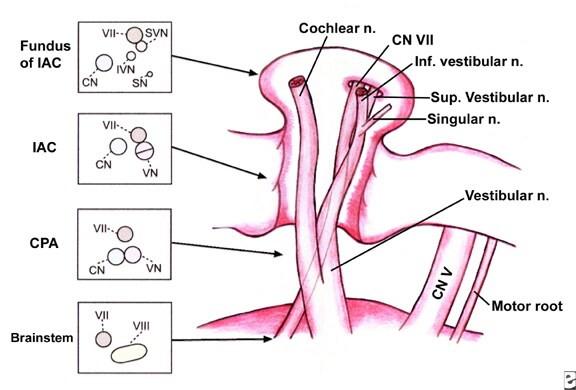
But back to my being dizzy.  I am starting to wonder if the dizziness isn't a result of nerve regeneration gone wrong.  The seventh cranial nerve is very close to the ear as well as very very close to the vestibular system.


Ignore the orange lines.  I posted the image more to demonstrate how close Cranial Nerve VII is to the ear.

The seventh cranial nerve also happens to sit VERY close to the eighth cranial nerve, which is in charge of the vestibular system. 

That picture is maybe hard to understand, but if you look up in the top right, you see CN VII (cranial nerve 7), and right in front of it sits the vestibular nerve.

My theory is that just as my nerve f*ed up by connecting my nose and my eye, it too also may have regenerated incorrectly near my vestibular system, causing chronic dizziness.

I've been thinking about my inner ear's involvement for six weeks or so.  I realized that when I took Xanax for anxiety I also experienced a decrease in dizziness.  I remember an ER doctor telling me that they sometimes used Valium to treat dizziness, so I started researching what it is about that class of drugs that alleviates that symptom.  Apparently, Valium and Xanax are vestibular suppressants that interfere with the nerve endings in the inner ear.

If the Bell's Palsy somehow damaged the vestibular functioning, it would make sense why the only meds I have responded to have been the vestibular suppressants.

The bad news: antibiotics aren't going to fix this.

I have an appointment in person Friday with the Lyme doc, at which point I'm going to show him my theory and see what he thinks.

Thursday, December 9, 2010

My Lyme Disease is not the IDSA Lyme Disease - Brooke

My Lyme disease is not the IDSA Lyme disease.

But it could have been.

On November 6, 2008, I woke up in a foreign place, not knowing that the landscape of my life was about to dramatically change (again).  My house had already burned down while I was eight months pregnant, and my son was six weeks old.  I had just returned to work as a special ed teacher.  I loved my work, and I loved understanding the research behind my teaching.  I was smart, engaged, resilient.

But that morning my orange juice didn't taste right.  I picked up a turkey bacon egg sandwich from Starbucks, too busy to cook breakfast between my newborn, the rebuild, and needing to be at work an hour early to make up for maternity leave.  That didn't taste right either.  By the time my resource students came to me for their writing class I felt like I was talking with braces on even though they had been removed over a decade earlier.  At lunch I went home to nurse my son.  I looked down at his bright blue eyes, and I smiled.  Or rather, I tried to smile.  I jumped out of bed and ran to the mirror to discover that the entire right side of my mouth could not move.  Having always believed if I tried hard enough to do something I could do it, I thought really really hard about smiling and tried to will my muscles to move.  Instead, they sat motionless on my face, the resulting smile a half-moon shaped expression of fear.

I was scared.  I only had another hour left of classes, so I decided to head back to work, not wanting to miss anymore teaching hours.  A half mile down the road, I stopped blinking.  I turned around and we drove to the ER.  The only scenario I could think of was a stroke or cancer.  Why else would someone lose function in the entire right side of their face?  But I was calm.  I had no control in that moment over my paralysis, and the doctors would surely figure out what was happening.

A very kind and confident doctor strolled in a few minutes after we were triaged.

"Bell's Palsy," he said, not even wavering in the diagnosis.  "We see this all the time.  Take some steroids, and you'll regain function in a couple of weeks."

There was nothing benign about my face being paralyzed.  "Are you sure it's nothing else?" I probed, concerned that absolutely no medical tests had been run.  I was told to follow-up with a neurologist.

For the next few weeks, I looked like this:

I know I have posted this picture before, but I feel it is very important to this story to see what the devastation can look like.  I firmly believe that no amount of psychosis could possibly create the paralysis that was so evident to those around me.

I did go to a neurologist.  He said I was fine.

Things got really bad on Thanksgiving.  I couldn't eat.  I was exhausted, and not just new-mom exhausted.  I couldn't move.  Sitting up in my chair seemed laborious.  And I laid down in my dad's guest bedroom and slept while others held my sweet baby boy.  The next day we left for a trip to San Diego.  I needed an escape.  Instead of a relaxing vacation though, we sat in our hotel room, and I slept.  We ordered room service because I was so dizzy, eating out made me nauseated.  I honestly thought I was going to die that week as did my husband who had already considered what he would do if I didn't survive.  I often think back to that trip and wonder if I would have been diagnosed if I had gone to the ER there.

I made myself a promise that if I wasn't better by January I would return to the neurologist.  I wasn't.  He ordered an MRI, and when it came back normal, he told me we would never know the cause of my dizziness.

The next eight months involved eight ER visits for chest pain (inflammation that I didn't learn about until I was diagnosed), routine visits to my GP, including requesting (but never getting) a Lyme test because I had been told by the therapist seeing us for the fire that Bell's Palsy could be Lyme related, and a five month wait to see a much better neurologist.  I also tracked my symptoms and noticed that I got better one week out of every five.

I never went to the internet to self-diagnose.  I trusted my doctors.  Because of my meticulous note taking, my neurologist ordered a lyme panel given the cyclic nature of my symptoms.  I was positive.

But even that wasn't enough to convince the doctors here, and I immediately sought out the opinion of an ILADS-associated doctor who knew far more about Lyme than the doctors in our area who rarely see Lyme.

If the ER doctor had asked about tick exposure in other areas of the country when I presented with Bell's Palsy it is likely I could have saved myself and my insurance thousands of dollars in expensive medical procedures and treatment.  I also would have been given antibiotics instead of steroids, which are known to suppress the immune system.  Because it took a year to even get a Lyme titer run, I have a complicated Lyme case, one that requires a longer course of treatment than the 28 days prescribed by the IDSA.  And my LLMD is very knowledgeable about the other infectious agents, and by treating with a multi-pronged antibiotic regime, we have managed to beat back this disease.

The good news I am better.  My joint pain is gone.  The fatigue that had me bed-bound is now nearly gone.  The neuropathy is gone.  The light sensitivity has abated.

I still have some cognitive deficits.  I used to edit articles and books, and now I struggle with spelling common words.  I also still have unrelenting dizziness that has yet to respond to treatment.  And I have some residuals from the Bell's Palsy. 

Chronic Lyme isn't some concocted diagnosis by patients imagining they are sick.  Nor is it a get-rich-quick scheme manufactured by ILADS.  We are real patients, patients who have suffered the ignorance of not only the medical profession but the community at large.  It takes years to undo the stigma of psychiatric illness, and reducing those who are truly suffering to a bunch of fringe lunatics willing to do anything to cure their psychosomatic problems is not only ignorant, it's morally reprehensible.

I have Lyme Disease.  Only my Lyme Disease is not the IDSA Lyme Disease.

This post is in response to the Tribune article I wrote about here.

MORE STORIES:

Wednesday, December 8, 2010

Dubious medicine a product of dubious journalism

The Chicago Tribune published an article today titled 'Chronic Lyme disease' diagnosis gains traction despite lack of evidence.    In the article, the writers, who can hardly be called journalists, tow the IDSA party line stating that Lyme disease, in its most severe forms, is easily treatable with 10-28 days of antibiotics.  They question the Chronic Lyme diagnosis as essentially a web-phenomenon that is making a handful of Lyme-literate physicians wealthy.

Lyme docs (or LLMDs) often do not take insurance.  They can't.  Their medical licenses have been revoked for prescribing medicine outside the purview of the very narrow antibiotic treatment guidelines.  My doctor, as well as a number of the LLMDs I've encountered in my discerning research, have been touched personally by late stage Lyme.  They aren't doing this to get rich.  They are trying to treat patients who are otherwise cast aside.  If the comments on the Tribune are any indication, there are a number of people who think a trip to the psychiatrist will fix us all right up.  I've also read non-Lyme friendly doctors question how much the placebo effect plays into the recovery of Lyme patients.  Of course, the placebo effect explains why some antibiotics have worked for me and others haven't.  And why the ones I REALLY expected to work, didn't.  And yet because of antibiotics I am, at the least, functionally sick (or chronically well). 

The Tribune then went on to publish another piece in their journal explaining their reasoning behind publishing the original article (I guess they didn't like the Lyme community descending upon them like... ticks).  They reiterate their concern that the overuse of antibiotics by Lyme patients is a public health nightmare and puts everyone at risk.  That argument makes me so livid.  Of course we shouldn't minimize the reality of antibiotic resistance.  But if we can treat zits with long-term antibiotics, I think it's at least worth a shot to try to treat chronic illness the same way.  As LymeMD once said, does it really matter in the end what the offending organism is if the treatment is effective?  And by offending organism, I don't mean a psychosomatic disorder requiring psychiatric help.  There ARE some crazy people who are sick for attention.  But we can't all be crazy. 

Following is my response to the second Tribune article, which I am waiting to be approved:
"Considering your concern for public health and the use of antibiotics, I'm assuming you will be doing a follow up piece on the treatment of acne using long-term antibiotics.  If a possible life-threatening disease is not worth the antibiotic risk, I'm assuming you believe that zits aren't either.
And as numerous commenters pointed out, the use of antibiotics in the meat supply is likely a far greater contributor to antibiotic resistance than use in Late-Stage Lyme patients. 
I think the biggest concern with your article is the obvious oversight in your ability to actually read ANY of the science.  A recent study showed the persistence of Lyme bacteria in "adequately" treated animals.  There are a number of respected scientists examining this issue, and watching any of the recent conferences would, I think, cause you to consider that perhaps this is more than just "modern dubious medicine."
The one thing your article did point out is that as long as it's presumed there is a cure, there is no need for us to continue researching.  Unfortunately, treatment failures do exist, and it is my hope that research will continue so that we can eradicate the multiple chronic infections that have destroyed so many lives."

Let me be very clear: I believe in science.  There are plenty of Lyme conspiracy theories, and I do not believe they help further the sanity of any of those fighting this battle.  I believe in controlled, randomized studies.  I believe in clinical trials (my dad's life was saved by one, even though it did not get FDA approval in the end).  But I also believe that we don't know everything that we need to know, and often clinical judgment is required.  So when I'm looking for a doctor to treat Lyme, a disease that little is known about, you bet your ass I'm going to pay the extra money to go see a doctor who treats Lyme often (as opposed to once in ten years).

I wish that we were ten years down the road in research.  I really do believe there is some incredible research being done at those dubious schools like Columbia!  I thought some great points were raised at the Institute of Medicine's summit on Lyme this year, even if dissenting viewpoints were brought in begrudgingly.

The Tribune did nothing for Lyme patients today.  In fact, they made it more difficult to get recognition by other doctors, doctors I don't go see because of the pervasive attitude like those expressed in today's article.

And the point being made at the end of the article by the patient who was essentially vilified was that maybe if the doctors who turn their head to this epidemic were to fall sick to Chronic Lyme, change, real change, would be made in fighting a disease that so many of us want to just put behind us.

Tuesday, December 7, 2010

Day three off Mepron

So I'm functional. 

But I'm sick. 

The air hunger is decidedly worse.  The dizziness is bad. 

But I'm off the couch, and I can keep down a meal.  How's that for a catch 22?!

I need to restart.  But it's hard knowing it will make me feel worse. 

Have I mentioned how much I hate these cluster of diseases?!

Monday, December 6, 2010

Get sick to get better?

As you might know, Mepron has kicked my ass.  I went from functionally ill to bedridden. 

So I stopped the drug. 

Two days later, and I'm functional again. 

Maybe this is the wrong decision.  I don't know.  Maybe my body will adjust.  Maybe I have to get sick before I get better.  But I'm just not in a place where that's an acceptable response.

There are many in the Lyme community who believe this get sick to get better theory.  They call it a herx, though I've heard people question whether it is the same thing as the initial Herxheimer reaction that occurred with syphilis.  The thing is, though, I've never herxed with any drug.  I've only gotten better.  And then stalled out.

I'm dizzy.  So so dizzy.  And I have to take really deep breaths to feel like I'm getting enough air.  Other than that, I'm better.  I have more energy.  My muscles don't hurt.  My joints don't hurt.  I'm functional, though being dizzy all the time does have some major drawbacks, as I'm sure you can imagine.

The question is do I give up feeling relatively good to go through several weeks of hell to the point that I am literally housebound, in hopes that I feel better in the end?  Are there other alternatives that might not make me as sick?  Is it possible that at this point the meds are causing some of the symptoms? 

I really don't know the answers, but we're going to be bringing this up to the doctor when we go see him next Friday.  For now, I'm resuming my functionally sick life.

Saturday, December 4, 2010

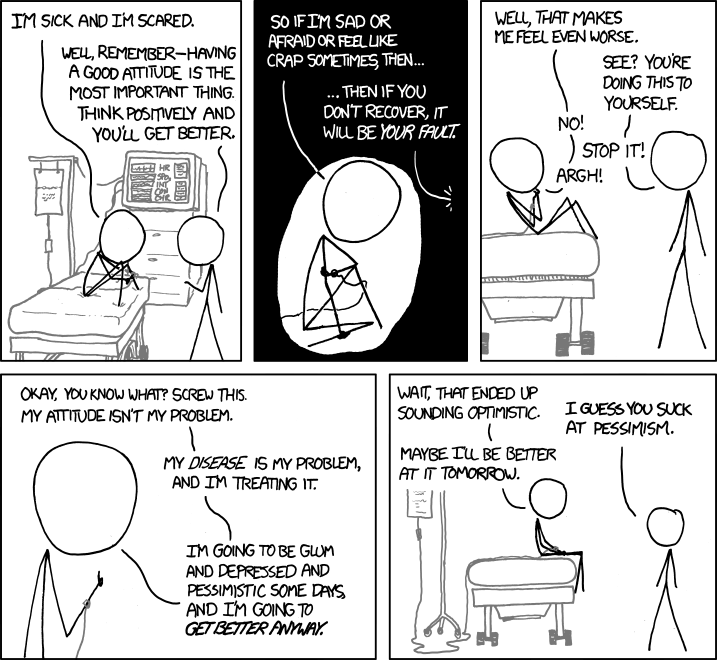
A positive attitude won't cure me


When I was in high school, we attended a Unity Church, which believes very strongly in the power of positive thinking.  One day in my class we talked about being able to use positive thinking to stay well.  I told the teacher it was complete crap!  Bacteria and viruses cause illness, not our thoughts.

A few years ago, the Secret was the big new age thing.  Same principle.  Same objections.  I've always had an issue with the belief that medical problems were simply mind over matter.  An infant is not suffering because of his or her negative thoughts.  I didn't get Lyme because I gossiped.  I got Lyme because a tick bit me.

And I'm not going to get better by willing myself healthy.  I promise you if that were the case, I would be living my life as a very healthy mother.  I feel like sometimes when I complain, others want me to banish the negative, sick thoughts, but really, if they were stuck in bed, barely able to eat, barely able to move really, they might have a few complaints too.

It's not that I don't believe in thinking good thoughts.  I do.  I have been to a hypnotherapist and often listen to my CD before bed to help me sleep better and relax.  But I don't think it's so simple as to think good thoughts.  And it actually rather annoys me to hear such absurdity.

Thursday, December 2, 2010

The Lyme life

It's 7:19.  I just started my IV for the night.  Who'd have ever thought I would become so proficient at doing infusions?!  But they are as much a part of my life now as brushing my teeth. 

The new meds are making me feel pretty badly.  Because of the snow and Kellen's cold (which is now my cold) we haven't left the house much since Thanksgiving.  It's good because I get to rest.  But, I also think the less I do, the more tired I realize I am.  It's easier to think I'm better when I get out of the house, run a few errands, get some fresh air.  Instead, this week I've spent a lot of time watching TV from my couch. 

My appetite is also shot.  I go from being so so hungry that nothing can make me full to a place where absolutely nothing sounds good.  I ordered Chicken Parm from a local restaurant tonight, and it was SO good.  I shouldn't have eaten it all.  I certainly wasn't hungry.  But I ate it.  And it was good to eat a big meal (I ate relatively little at Thanksgiving).  I still have to eat my nightly fat so that I can take Mepron.  I'm hoping egg nog is enough because I don't think I can manage anything else. 

There are so many things on my mind to write, but I'm just so tired.  It's hard for me to believe that this is me, better.  I don't have shooting electric shock pains anymore.  I am not nearly as tired as I was the year I went undiagnosed.  The neuropathy has diminished and is almost nonexistent most weeks.  The joint pain is mostly gone.  These are things to be celebrated.  But now, with this new drug, I am tired again, no energy for celebration.  And I still don't feel like I can get a good breath.  And I'm dizzy.  It's the symptom that won't relent.  I have hope that this combination of meds tips the scales for improvement. 

Tonight I'll listen to my hypnotherapy CD before I go to bed, hopefully giving me another solid ten hours of sleep.

This is the lyme life and certainly not what I imagined my twenties to look like.